For major depressive disorder (Adjunctive) in adultsOpen-label safety trial (Study 503) in adults

Patients on CAPLYTA sustained treatment over 6 months1,2

9 out of 10 patients chose to continue into the open-label safety extension, and 85% of patients stayed on CAPLYTA during the 6-month, open-label safety trial

  • Safety profile observed in the open-label trial was consistent with pivotal trials

Change in depression symptom severity score over 6 months3

Swipe chart for more
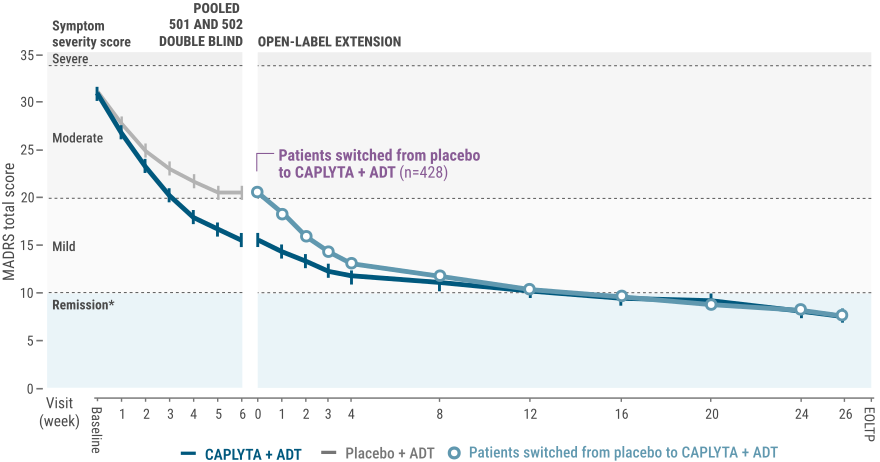
MADRS total score over time3,4
This line graph shows changes in MADRS total scores over time from baseline through 26 weeks for patients receiving CAPLYTA 42 mg or placebo.

80% of patientsmet clinically defined response(reduction of MADRS total score ≥50%)2

65% of patientsmet clinically defined remission(MADRS total score of ≤10)2

Limitation: This open-label safety extension trial was designed primarily to assess long-term safety and tolerability. Efficacy outcomes are exploratory and should be interpreted with caution, as the study was not powered or controlled to assess treatment efficacy.

*Remission defined as MADRS Total Score ≤10.

ADT=antidepressant therapy; EOLTP=end of open-label treatment period; MADRS=Montgomery-Åsberg Depression Rating Scale.


Study 503 - open-label safety trial in adults2,5

Study design

Study 503 was an open-label safety extension study of patients with MDD continuing to receive CAPLYTA 42 mg adjunctive to an antidepressant (N=809).

  • Eligible patients completed lead-in Study 501 or Study 502
  • Open-label treatment period: Weekly visits through Week 4, then every 2 weeks through Week 265
  • Primary outcome measure: Safety and tolerability
  • Secondary outcome measures: Maintenance of depressive symptoms, measured by MADRS total score change from Study 501 or 502 baseline to Week 26 of open-label treatment

Limitation: This open-label safety extension trial was designed primarily to assess long-term safety and tolerability. Efficacy outcomes are exploratory and should be interpreted with caution, as the study was not powered or controlled to assess treatment efficacy.

The primary endpoint of the open-label trial was safety and tolerability of long-term CAPLYTA 42 mg adjunctive to ADT as assessed by AEs and vital signs (all visits) and clinical laboratory parameters and electrocardiogram findings (Day 1, Weeks 1, 8, 16, and 26). Suicidal ideation and behavior were assessed by the C-SSRS at every study visit and by AEs. EPS were assessed as AEs and by symptom rating scales, including the Abnormal Involuntary Movement Scale (AIMS), the Barnes Akathisia Rating Scale (BARS), and the Simpson-Angus Scale (SAS) (Day 1, Weeks 1, 4, 8, 12, 16, 20, 24, and 26).

AE=adverse event; EPS=extrapyramidal symptoms; C-SSRS=Columbia-Suicide Severity Rating Scale; MADRS=Montgomery-Åsberg Depression Rating Scale; MDD=major depressive disorder.

Full graph description

This graph depicts the change in depression symptom severity score in pooled 501 and 502 studies and the open-label extension Study 503. Also shown is patients receiving placebo + ADT in Study 501 and Study 502 that switched to CAPLYTA in Study 503. All patients in Study 503 received CAPLYTA + ADT over 6 months.2

References: 1. CAPLYTA Prescribing Information. 2. Durgam S, Earley WR, Kozauer SG, Chen C, Lakkis H, Cutler AJ. Long-term adjunctive lumateperone 42 mg treatment in major depressive disorder: results from a 6-month open-label extension study. Eur Neuropsychopharmacol. 2026;108:112786. doi.org/10.1016/j.euroneuro.2026.112786 3. Data on File (REF-02960). 4. Thase ME, Harrington A, Calabrese J, Montgomery S, Niu X, Patel MD. Evaluation of MADRS severity thresholds in patients with bipolar depression. J Affect Disord. 2021;286:58‑63. doi:10.1016/j.jad.2021.02.043 5. An open-label study of lumateprerone as adjunctive therapy in the treatment of patients with major depressive disorder. ClinicalTrials.gov. Identifier: NCT05061719. Updated December 19, 2024. Accessed October 22, 2025. https://clinicaltrials.gov/study/NCT05061719