For SCHIZOPHRENIA in adults84% of patients were relapse-free with CAPLYTA over 6 months1*

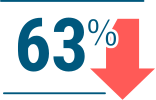
CAPLYTA significantly delayed time to relapse vs placebo1,2
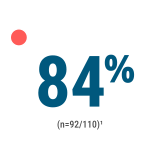
Relapse free imagerelapse-free
over 6 months1*
Reduction in risk imagereduction in risk
of relapse1†
Relapse image

Reconsider your schizophrenia treatment approach.
Prescribe CAPLYTA for your appropriate patients2

Doctor image

*In the ITT population, fewer relapses occurred with CAPLYTA (n=18, 16%) vs placebo (n=44, 39%); Clinical significance, NNT=5.¹

HR (95% CI): 0.37 (0.22–0.65); P=0.0002. P value for prespecified primary analysis using the log-rank test. Estimates of HR and 95% CI based on the Cox proportional hazards model with treatment group as the explanatory variable.¹

Secondary Endpoint: Double-blind treatment period

CAPLYTA significantly delayed time to all-cause discontinuation (including relapse) vs placebo1‡

Reduction risk imagereduction in risk of
all-cause discontinuation
Patients on CAPLYTA
were less likely to
discontinue treatment1‡
31%
CAPLYTA (n=34)
53%
Placebo (n=60)
Discontinuation icon

Based on ITT population.¹

§HR (95% CI): 0.49 (0.32–0.75); P =0.0007. P value based on log-rank test. Estimates of HR and 95% CI based on the Cox proportional hazards model with treatment group as the explanatory variable.¹

CI=confidence interval; HR=hazard ratio; ITT=intent-to-treat.

Relapse study design1,2

Open-label treatment period: Adults (N=592) aged 18–60 years with schizophrenia experiencing a current psychotic episode received open-label CAPLYTA 42 mg once daily for 18 weeks. The mean treatment duration was 74.8 days during the open-label CAPLYTA treatment period.

Double-blind treatment period: Patients (n=228) who achieved stability by the end of the 6-week run-in period and were still stable at Week 18 were randomized 1:1 to double-blind treatment with CAPLYTA 42 mg or placebo for 26 weeks or until relapse. During the double-blind treatment period, mean treatment duration was 144.5 days for the CAPLYTA group and 111.9 days for the placebo group.

Primary endpoint: Time to relapse during double-blind treatment.

18-Week Open-label CAPLYTA 42 mg

6-Week
Run-In
12-Week Stabilization

Week 18

Stable
Patients 1:1

26-Week Double-Blind Treatment

CAPLYTA 42 mg
Placebo
To Week 44
or Relapse
Enrolled:
  • 18-60 years (incl)
  • DSM-5 schizophrenia ≥1 year
  • PANSS total score 70-120 (incl) at visit 1 and visit 2
  • Score ≥4 on ≥2 PANSS items at visit 1 and visit 2

At the end of the run-in period, stable patients continued treatment in stabilization period and others were discontinued

Stable defined as:
  • PANSS total score ≤60
  • ≥20% PANSS total score decrease from baseline
  • CGI-S score ≤4
  • Score ≤4 on 7 PANSS items
  • No suicidal or homicidal ideation
  • No tolerability issues
Relapse defined as ≥1 of:
  • Psychiatric hospitalization or increased psychiatric care
  • PANSS total score increase by ≥30% (if score ≥50 at randomization) or ≥10 points (if <50 at randomization)
  • CGI-S score increase by ≥2 points
  • Aggressive/violent behavior or self-injury
  • Suicidal or homicidal ideation
  • Score >4 on ≥1 of 7 PANSS items

PANSS items P1 (delusions), P3 (hallucinatory behavior), P2 (conceptual disorganization), and P6 (suspiciousness/persecution).¹

PANSS items P1 (delusions), P2 (conceptual disorganization), P3 (hallucinatory behavior), P6 (suspiciousness), P7 (hostility), G8 (uncooperativeness) and G14 (poor impulse control).¹

CGI-S=Clinical Global Impression-Severity of Illness scale; DSM=Diagnostic and Statistical Manual of Mental Disorders; PANSS=Positive and Negative Syndrome Scale.

References: 1. Data on File (REF-03262). 2. CAPLYTA Prescribing Information.